
Beneficial Fire
“California’s landscapes are, and always have been, shaped by fire. It’s not a question of whether these places will burn; it’s a question of when and how. Now is the time to elevate the voices of California's Indigenous and local communities—the original stewards of fire—and to work together to bring beneficial fire back to California's landscapes and people.”
– Lenya Quinn-Davidson, Director, UC ANR Fire Network
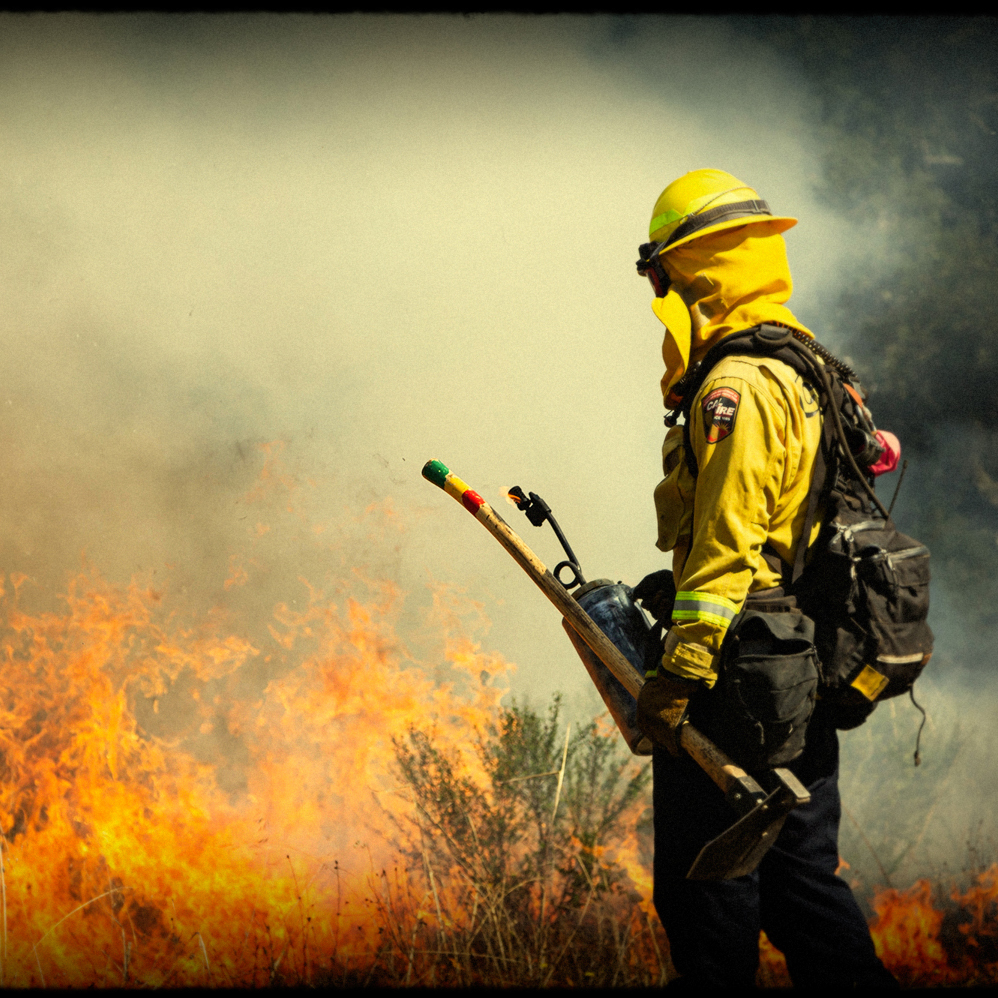
Many of California’s fire-adapted ecosystems now sit outside their historical fire regimes, fueling destructive wildfires. “Beneficial fire,” including prescribed fire, managed wildfire, and cultural burning, restores fire to these landscapes, reducing extreme wildfire risk and supporting tribal stewardship and ecosystem health. The Task Force’s 2022 Strategic Plan set the nation’s first comprehensive roadmap and acreage targets, and Executive Order N-35-25 has since streamlined permits, accelerated funding, and prioritized cultural burning.
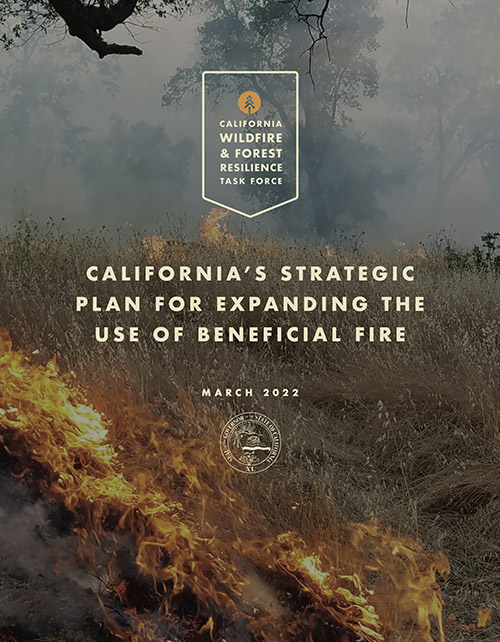
California’s Strategic Plan for Expanding the Use of Beneficial Fire
The Task Force published California’s Strategic Plan for Expanding the Use of Beneficial Fire in 2022, the nation’s first comprehensive roadmap with acreage targets across all land ownerships.
Key Accomplishments:
California continues to remove barriers and expand tools to dramatically increase the use of prescribed and cultural fire across the state.
- Developed a nation-leading framework for expanding beneficial fire: California’s nature-based solution targets call for significantly scaling beneficial fire across the state. California’s Strategic Plan for Expanding the Use of Beneficial Fire provides a vision and framework for rapidly expanding beneficial fire, and Executive Order N-35-25 directs a suite of actions to support tribes, local governments, and fire practitioners to maximize use of beneficial fire. State agencies have moved quickly to deliver on-the-ground results.
- Expanded prescribed fire: Task Force partners have nearly doubled prescribed fire statewide since 2021, treating roughly 200,000 acres annually. In May 2025, CAL FIRE, for the first time, met and exceeded its 50,000-acre goal for beneficial fire.
- Advanced cultural fire: Governor Newsom signed SB 310, which reduces barriers for tribes to conduct cultural burns in their ancestral territories. The Karuk Tribe and CNRA signed the first SB 310 Cultural Fire agreement in February 2025.
- Reduced liability barriers: CAL FIRE established a first-in-the-nation Prescribed Fire Liability Claims Fund with $20 million in state funding to cover losses from prescribed and cultural burns that escape control.
Key Actions:
California’s Wildfire and Landscape Resilience Action Plan identifies key priorities for the state to restore shrublands and forests that have been devastated by wildfire.
- 1.06 Enhance training and workforce capacity: CAL FIRE and CARB will collaborate with partners to accelerate the launch of the Beneficial Fire Training Network, expanding training opportunities for practitioners, air districts, local health jurisdictions, and regulators. Additionally, CAL FIRE, CNRA, and CARB are partnering with the University of California Agriculture and Natural Resources (UC ANR) Fire Network to expand beneficial fire outreach, education, research, capacity building and training.
- 1.07 Expedite implementation and streamlined permitting: Pursuant to AB 1699 (Rogers, 2026), CAL FIRE will provide direct assistance to local agencies and beneficial fire practitioners. Additionally, CAL FIRE will continue to streamline elements of the state burn permit process for eligible projects, and utilize template agreements to enable beneficial fire on state owned lands to better support burns led by non-CAL FIRE entities. CAL FIRE and the UC ANR Fire Network will share prescribed fire guidebooks. Consistent with SB 310 (Dodd, 2024), CNRA and local air districts will work collaboratively with federally recognized tribes to develop government-to-government agreements for cultural burning. CNRA and CalEPA will fast-track beneficial fire projects, pursuant to SB 1370. See Action 3.14 for more details on SB 1370 (Stern, 2026).
- 1.08 Expand local participation and reduce liability barriers Pursuant to AB 1699 (Rogers, 2026), CAL FIRE will continue administering the Prescribed Fire Claims Fund and expand eligibility for coverage to include public entities outside of CAL FIRE and the federal government, including resource conservation districts, volunteer fire departments, colleges and universities, and others in addition to the existing non-public user base. Permanent and expanded coverage will reduce liability barriers and increase the pace and scale of prescribed fire and cultural burning across private and public lands.
- 1.09 Expand and support cultural burning: CNRA, CalEPA, and their affiliated agencies will prioritize tribal consultation across the work of the agencies to support tribal leadership and incorporate tribal priorities into beneficial burning activities. Additionally, these agencies will strengthen partnerships with tribes through the creation of meaningful and durable access and collaboration agreements to enable cultural burning pursuant to the CNRA Tribal Stewardship Policy. CARB, in collaboration with air districts, will continue to collaborate with tribes to honor SB 310 air district agreements pursuant to Public Resources Code Section 4505. Also see Key Actions 4.01 through 4.05 on supporting tribal stewardship.
- 1.10 Improve smoke management consistency and coordination: CARB, with CAL FIRE support, will standardize early and frequent collaboration practices between practitioners and air districts. Together, they will identify best practices for smoke management plans that balance achieving beneficial fire objectives with reductions in public smoke exposure. They will also develop guidance to support longer burn authorization windows where feasible while improving public communication regarding smoke impacts and mitigations.
- 1.11 Strengthen modeling, technology, and reporting tools: CARB will develop and make available new modeling and related technologies, including updating the Prescribed Fire Information Reporting System (PFIRS), to support air districts and practitioners and promote faster, more efficient permitting.
- 1.12 Establish a Beneficial Fire Capacity Program: Subject to the availability of funds, CAL FIRE will establish a Beneficial Fire Capacity Program to expand training, organizational capacity, and support for community-led beneficial fire programs. CAL FIRE will also, subject to the availability of funds, continue to support these capacity-building initiatives through the Business & Workforce Development, Tribal Wildfire Resilience, and Forest Health Programs.
- 1.13 Use recent wildfires to expand beneficial fire: State, federal, local, tribal, and private land managers will evaluate how to incorporate recent wildfire burn areas into management plans, using wildfire edges as control lines to introduce beneficial fire to adjacent areas and reapply fire to lightly or moderately burned areas to maintain and reinforce landscape resilience.
- 1.14 Use Recent Wildfires to Expand Beneficial Fire: Public and private land managers will seek to incorporate recent wildfire burn areas into management plans, using wildfire edges as control lines to introduce beneficial fire to adjacent areas.
Regional Considerations
While Beneficial Fire is essential to landscape resilience across much of California, beneficial fire may not be an appropriate tool in areas that are already experiencing fires more frequently than they did historically. For example, in Southern California shrublands, too much fire can lead to conversion of native vegetation to more flammable non-native grasses, resulting in even greater fire risk.
CASE STUDY:
A Landmark Cultural Burn Agreement
In March 2025, The Karuk Tribe and the California Natural Resources Agency (CNRA) signed the first cultural burning agreement under SB 310. This landmark legislation and agreement acknowledge tribal sovereignty and addresses historical injustices while contributing to the mitigation of catastrophic wildfire by enabling CNRA and local air districts to enter into agreements with federally recognized California Native American tribes to support them in conducting cultural burns in their ancestral territories.
Work Group: Beneficial Fire
Partnering Organizations
Work Group leads
CAL FIRE – Frank Bigelow, Key Action Lead
CAL FIRE — John Morgan
Fire Restoration Group – Craig Thomas
U.S. Forest Service – Stephen Fillmore
CAP COA – Larry Greene
CSU Chico – Don Hankins
Len Nielson, CAL FIRE
Lance Noxon, U.S. Forest Service
Work Group Facilitator
Hannah Hepner, The Watershed Center